Based on my target audience which is teenagers between the ages of 16-19 who are students at either college or university, I would say that the best way of gaining feedback from people this age is by using the tracking method (cookies) as they wouldn't need to fill anything in and wouldn't take up their time when they have better things to do. The next best way of getting feedback would be ratings as this time it only takes a second of their time to click a button. The one that I would wouldn't or would least likely use would be questionaires because they would get annoyed with the fact that it would take up their time and they wouldn't want that. If there was a questionaire I think that the target audience would stop visiting the site.
The audience that I am aiming this website at is Teenagers and young adults as they are more likely to understand about how and why the bees are endangered. They also have more power to do the right thing and also if they don't help or contribute to protecting the bees they are the ones who will be affected in the long run as their generation will have less food sources. The food sources would be scarce as the bees would no longer be pollinating the plants and different foods that they do and the foods that they eat which means that they will not have the same sources that they have now and they will have to adapt and change what they eat and find other ways of getting the supplements that they need from other foods. The ages of the target audience I would say that the age that I would say are 16-19 years old and I would aim it at both males and females. This means that they audience are students either in college or university which will mean that the audience wont have much of an income and most will still be living off their parents money.
The purpose of the website will be that I will be creating will be to help people protect and save the bees. The website will show and tell people how they can help the bees and also help them to understand why they are endangered and why they should be protected. It will contain information about the bees and how they can be looked after.
Albert Einstein- 'If Honey Bees become extinct, human society will follow in four years'
Bees are facing extinction. If the worlds bees died out then a lot of our food sources would go with them. Supermarkets would lose over half of the fruit and vegetables that are on their shelves. Bees are an important species as they pollinate 70 of the 100 crop species that feed 90% of the world. One of every three bites of food has come from plants that are pollinated by bees and other pollinators. Bees are really essential to the human diet. If they died out it would be a struggle on a global scale as the population of 7 billion people would be hard to sustain without most of the crops that bees pollinate.
Some foods that would go are:
apples
onions
avacados
carrots
cantaloupe
summer squash
broccoli
mustard greens
mangoes
lemons
limes
honeydew
zucchini
egg plant
broccoli rabe
cucumbers
green onions
cauliflower
leeks
bok choy
kale
Honey bees are responsible for around £19.4 billion a year in crops.
If bees died out we could lose plants that they pollinate, then also the animals that those plants feed.
We are losing bees at an alarming rate. Some reasons for this could be:
the loss of flower meadows
the use of pesticides and insecticides
climate change
the crab-like varroa mite that feeds off a bees blood
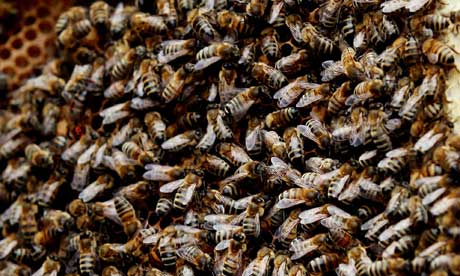
No birds, just bees. Photograph: Graeme Robertson for the Guardian
In the past six years, more than 10m beehives have been wiped out from a mystery disease called colony collapse disorder. This destruction has serious implications on worldwide ecology and economy.
Of the 100 crop species responsible for providing 90% of food worldwide, 71 are dependent on bee pollination, according to UN estimates (pdf). It's difficult to pinpoint the financial implications of this destruction, but the international body says pollination is worth between $37bn and $91bn, annually.
Stories about the declining population and its effect on the environment trickle through the news cycle each week. To bring awareness to these stories and contextualize the issues, we will highlight the major bee-related stories every Tuesday, with analysis from The Guardian's Alison Benjamin, co-author of A World Without Bees, Bees in the City: The Urban Beekeepers' Handbook and Keeping Bees and Making Honey. She is also a beekeeper.
What happened?
Bees pollinating crops including watermelon, cucumbers and blueberries return to their hives with pollen contaminated by agricultural chemicals – leaving insects more susceptible to a lethal parasite, according to a study published online last week. Pollen filled with fungicides, insecticides and other agriculture chemicals was fed to healthy bees, that were then more likely to be infected by Nosema ceranae – the parasite linked to the decimation of honey bees. Key quote
Fungicides, which we didn't expect to harm insects, seem to have a sub-lethal effect on bee health," Dennis vanEngelsdorp, an entomologist at the University of Maryland and senior author of the new study, told NBC News. He said this is important because fungicides aren't heavily regulated.
Why it matters:
Colony collapse disorder is caused by a combination of factors – parasites, agricultural chemicals and poor nutrition. These all weaken the honeybees' immune system and make them more susceptible to viruses and infections that can kill them. Up until now concerns around agricultural chemicals and honeybees have focused on the impact neonicotinoid pesticides are having and a temporary ban has been imposed on three types by the European Commission. Yet, this study shows that fungicides used on many crops pollinated by bees can also have serious consequences. Attention now needs to turn to these chemicals and to ensure that tests are conducted when they are registered for use which protects honeybees.
What happened:
The fact that different kinds of bees prefer different kinds of flowers lead two researchers in Colorado to wonder what would happen if an entire bee species disappeared. So they removed (using nets and traps) the most numerous bumble bee species from a meadow in Colorado. The question: would the other bee species pick up the slack and continue to pollinate the abandoned flowers? Or would they leave the plants to die?
The result: the remaining bumblebees became less faithful to one flower species than they had been before the more populous bees had been around to keep them in line. This had a serious impact on the tall larkspur, a lovely purple wildflower, who needs its own pollen to reproduce (aka a faithful bee partner). Key quote:
It is not just honeybees that pollinate crops and flowers, bumblebees and solitary bees do too. And there are many more varieties of bumblebees and solitary bees than there are honeybees. In fact we only have one species of honeybee in the US and Europe and Australasia – Apis Mellifera; the western honeybee. Many bumblebees and solitary bees have evolved to pollinate certain flowers. They have a symbiotic relationship – the flower needs the bee to pollinate it and the bee needs the nectar and pollen from the flower to provide protein and energy for itself and the baby bees. If the bee dies out that flower will soon follow and the ecosystems fall apart.
We don't keep bumblebees and solitary bees, but we can do things to improve their habitat from creating bee hotels – a collection of hollow plant stems – where solitary bees can lay their eggs to leaving a pile of leaves in the garden where bumblebees can nest.
What happened:
We hit peak bee crisis this week when Martha Stewart, queen of domestic perfection, started tending to her own bee hives and coaching readers on how to take care of their own. Key quote:
With the epidemic hive failures and disappearance of many colonies, beekeepers have new concerns about maintaining their hives. In fact, Martha's own colony has experienced a collapse over the years as her own bees left in a "mass exodus," and she had to re-establish much of the colony within her four hives, prompting her to send out her message to all other would-be keepers out there.
Why it matters:
The decline in honeybees has led to an unprecedented surge in the number of new beekeepers around the globe. It has become very fashionable for young, urban professionals to keep bees on roof tops and backyards. But beekeeping is a perilous pastime because bees can die during the winter of starvation, or they can be overrun with the varroa parasite if not treated correctly. It can be expensive restocking your hive every spring. Probably a more effective way to save honeybees and other bees is to make your neighbourhood more bee-friendly by planting bee-friendly flowers and trees in your garden and in your parks and streets – bees need flowers throughout the year, from very early spring to late autumn – ditching any weed killers which can include harmful chemicals, and replacing driveways and decking with wildflowers.
What happened:
When bees become disruptive in cities, local governments are favoring the relocation of bees over extermination. This specialized process requires beekeepers and bee specialists to transport tens of thousands of bees to farms – in this instance Rodney Oakley moved 30,000 bees, the amount typically found in a small hive, in Austin, Texas. He told the Austin American Statesman that local honey bees struggle from the mix of drought conditions, increased used of pesticides and decreased diversity in crops. Key quote:
As more attention has been focused on the honey bee and its importance and decline, more people have been calling," Rodney Oakley said. "In communities that are more conscious of environmental issues, like Austin, they will search me out so that the bees aren't destroyed.
Why it matters:
Honeybees are important for pollination and to make delicious honey, so it's never a good idea to kill bees. They can live in harmony with people in urban areas if the beekeeper is responsible and ensures his bees don't swarm and annoy the neighbours. But if there are problems with the neighbours you should relocate your honeybees. And if you see a swarm of bees, you should contact a local beekeeping association or group. They will have a designated swarm collector who will come out and collect the bees and take them away.
What happened:
UK government scientist Dr Helen Thomspon is set to join chemical giant Syngenta. Thompson's research – including a field trial of neonicotinoids, the frequently used insecticide, on bees – was used by ministers to argue against a ban on pesticides. Key quote:
UK government policy should be informed by unbiased and disinterested scientific research," said Joan Walley MP, chair of the environmental audit committee, whose report in April accused the environment secretary Owen Paterson's department of "extraordinary complacency" over bees and pesticides. "This principle is undermined if the government research agency is too close to the pesticides industry and if scientists are zigzagging between the two.
Why it matters:
There has been huge controversy over the UK government's stance against banning certain pesticides implicated in bee deaths across the globe. The ban was introduced earlier this year Europe-wide despite the UK government's resistance. Environmental groups have accused the government of being too close to big agricultural companies such as Syngenta. Whether this is true or not, Dr Helen Thompson's move from government scientist to Syngenta does not inspire confidence that this government was acting in an impartial manner. What of other government scientists – are they too looking for very well paid jobs with the chemical giants? If so are they likely to be providing advice that is critical of their potential future employers?